Biodegradable vs Compostable Packaging: The Real Difference and the Certifications That Matter
Table of Content
- Why Europe Is Reassessing “Biodegradable” Claims
- Biodegradable vs. Compostable: A Regulatory Distinction
- Certification as a Procurement Safeguard
- Common Compostable Materials in Food Packaging
- Compostable Packaging as Risk Mitigation
Why Europe Is Reassessing “Biodegradable” Claims
Across the European packaging market, demand for sustainable foodservice solutions continues to increase. However, regulatory scrutiny over environmental claims has intensified in parallel.
European authorities are shifting their focus beyond sustainability positioning alone. Environmental claims are now evaluated against three key criteria:
-
Technical substantiation – Is the claim supported by verifiable scientific evidence?
-
Clear definition – Is the terminology precisely defined rather than broadly implied?
-
System alignment – Is the material compatible with existing waste management and recycling infrastructures?
As a result, terminology that was previously used as general sustainability signaling — particularly “biodegradable” — is now subject to greater regulatory and commercial examination.
Market Shift: From Perception to Regulatory Defensibility
European procurement decisions are no longer based solely on cost, functionality, or perceived environmental benefit. Buyers increasingly assess:
-
End-of-life pathway compatibility
-
Infrastructure alignment
-
Certification validity
-
Legal defensibility of environmental claims
In this context, materials described as “biodegradable” may appear to offer a lower-risk alternative to conventional plastics. However, the regulatory interpretation of biodegradability is more nuanced.
Biodegradable vs. Compostable: A Regulatory Distinction
Although often used interchangeably in commercial communication, “biodegradable” and “compostable” represent materially different classifications within the European regulatory landscape.
Biodegradability: A Conditional Property
Biodegradability refers to a material’s capacity to be metabolized by microorganisms into carbon dioxide, water, and biomass.
However, biodegradation is conditional rather than absolute. Its occurrence depends on:
-
Specific environmental conditions
-
Temperature and oxygen availability
-
Microbial activity
-
Exposure duration
A material that biodegrades in controlled soil conditions may not biodegrade in marine environments or landfill settings. In such cases, fragmentation rather than full mineralization may occur.
To mitigate misleading disposal assumptions and reduce microplastic accumulation, EU guidance requires that biodegradability claims be clearly substantiated. This includes explicit specification of:
-
The environment in which biodegradation occurs
-
The timeframe required for decomposition
Absent such clarification, biodegradability claims may expose economic operators to regulatory scrutiny and potential greenwashing allegations.
Compostability: A Defined and Testable Standard
Compostability—particularly industrial compostability—is a defined and testable classification under EN 13432, a harmonized European standard.
EN 13432, formally titled “Packaging — Requirements for packaging recoverable through composting and biodegradation,” serves as the official benchmark for determining whether packaging is suitable for industrial composting systems within the EU.
Certification under EN 13432 requires compliance with four mandatory performance criteria — all of which must be met:
- Biodegradability – Under controlled industrial composting conditions, the material must achieve at least 90% conversion to CO₂ within 180 days.
- Disintegration – After 12 weeks of composting, material fragments must pass through a 2×2 mm sieve, with residual mass not exceeding 10% of the original weight.
- Chemical safety – Strict limits apply to regulated heavy metals (e.g., copper, zinc, nickel, cadmium, lead, mercury, chromium) to ensure compost quality is not compromised.
- Ecotoxicity – Compost containing material residues must not negatively affect plant germination or biomass growth.
Importantly, EN 13432 certification applies to the final product, not merely the base resin. Thickness, inks, coatings, adhesives, and labeling components are evaluated within the finished packaging configuration. A certified raw material does not automatically guarantee certification of the converted product.
EN 13432 therefore defines compostability as a controlled-system recovery pathway, not a universal biodegradation claim. For distributors and importers, this distinction is critical when assessing claim accuracy and regulatory exposure in the European market.
Biodegradable vs. Compostable: Core Regulatory Principle
All compostable materials are biodegradable.
Not all biodegradable materials meet compostability standards.
Within the EU market, biodegradability claims that lack defined environmental parameters and timelines may constitute non-compliant environmental communication.
For importers and distributors, this distinction is not semantic — it is risk-based. Ambiguous claims increase regulatory exposure and potential reputational liability.
Certification as a Procurement Safeguard
In Europe, compostability qualification is primarily assessed under EN 13432. For distributors and importers, selecting SKUs supported by recognized third-party certification serves not only as a compliance safeguard, but also as a procurement risk-control mechanism.
Widely recognized certification bodies include:
-
DIN CERTCO DIN-Geprüft industrially compostable
-
TÜV AUSTRIA OK compost INDUSTRIAL (aligned with EN 13432 and Directive 94/62/EEC)
Beyond regulatory defensibility, these certification schemes deliver additional commercial value:
-
Reduced greenwashing exposure – Claims are supported by standardized laboratory testing rather than marketing language
-
Streamlined customs and importer review processes – Recognized marks simplify documentation checks during cross-border trade
-
Improved buyer confidence in negotiations – Third-party verification reduces verification burden for downstream clients
Certified products may also display the Seedling logo (managed by European Bioplastics), a pan-European visual mark indicating verified EN 13432 compliance. While the Seedling logo itself is not a certification body, it functions as a widely recognized consumer-facing indicator across European markets.
These schemes rely on traceable laboratory methodologies and standardized performance criteria, strengthening both compliance integrity and market credibility.
Common Compostable Materials in Food Packaging
Compostable food packaging in Europe is commonly manufactured from molded plant fibers, including:
- Sugarcane bagasse
- Bamboo pulp
- Wood pulp
From a technical standpoint, molded fiber containers typically tolerate temperatures of approximately 100–110°C. They are generally suitable for hot food applications and short-duration takeaway use.
However, most fiber-based packaging does not incorporate plastic linings or high-performance barrier coatings. Therefore, resistance to prolonged moisture exposure, high oil content, or liquid-intensive foods may be limited.
For distributors, performance validation under real-use conditions is as critical as certification review. Infrastructure compatibility, end-of-life routing, and application boundaries should be assessed prior to procurement.
ENPAK’s fiber pulp series are supported by industrial compostability certifications such as DIN CERTCO DIN-Geprüft industrially compostable and TÜV AUSTRIA OK compost INDUSTRIAL. Beyond certification alignment, the series offers diversified size configurations and format options designed to support portfolio expansion, menu flexibility, and differentiated positioning in competitive foodservice channels.
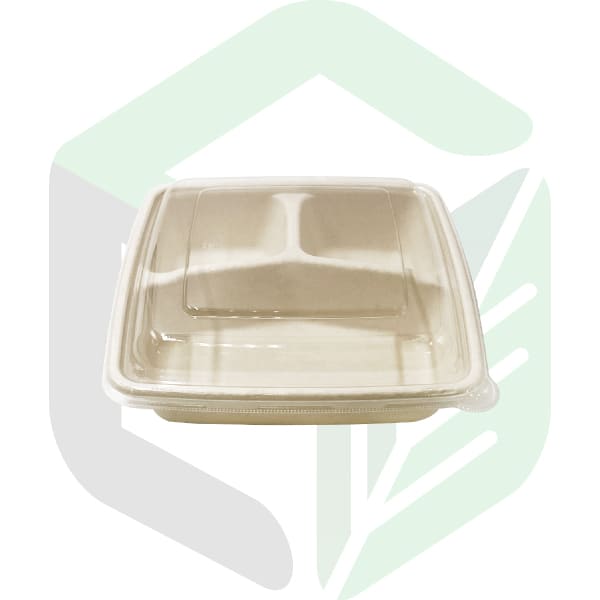 | 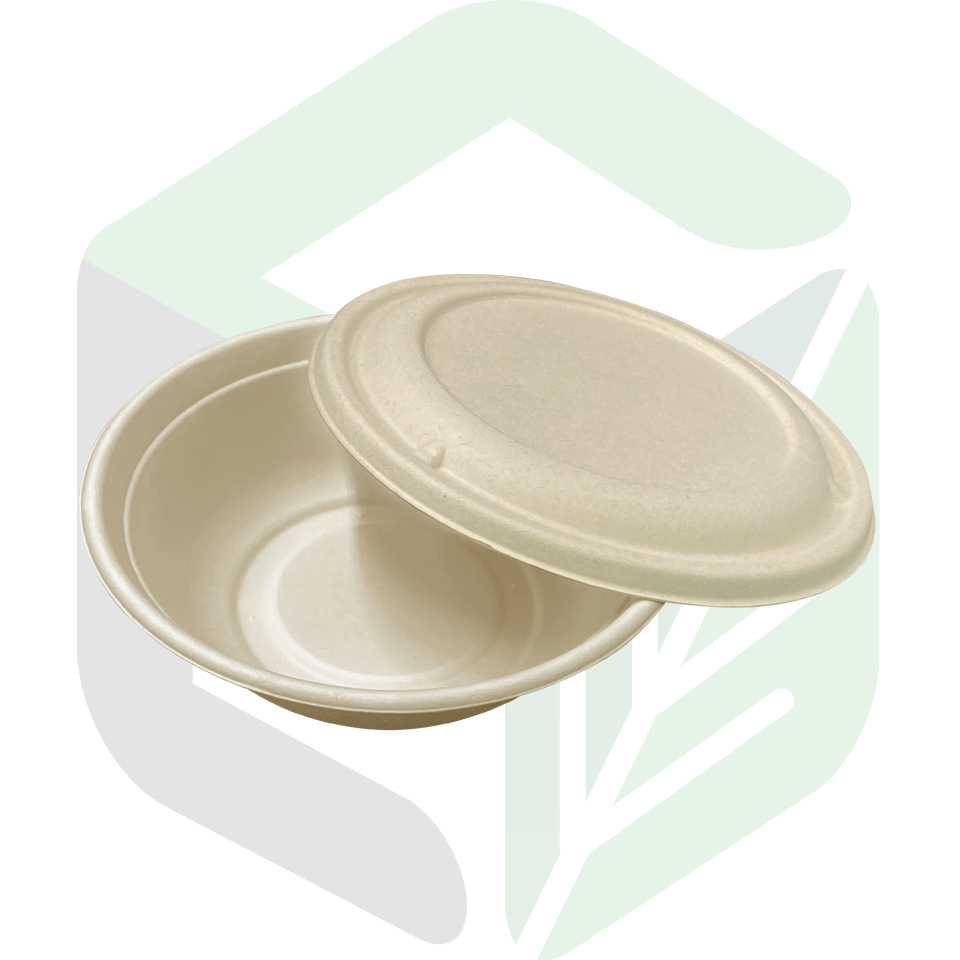 | 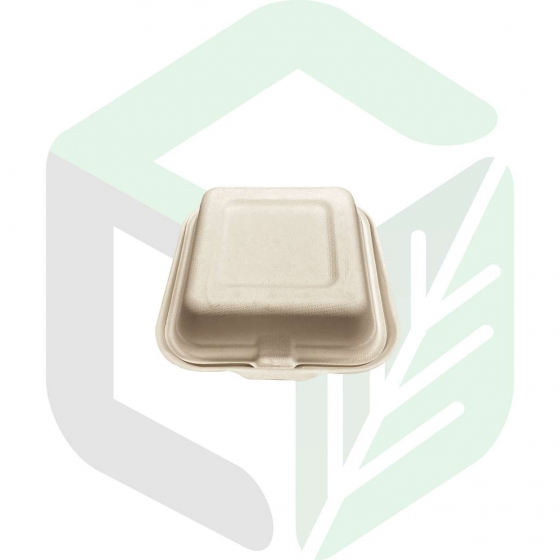 |
| Compostable Square Boxes 1000mL | Compostable Round Salad Bowl 32oz | Compostable Square Clamshell Boxes 6 Inches |
Compostable Packaging as Risk Mitigation
For economic operators active in the European market:
-
Biodegradable does not equate to compostable
-
Undefined biodegradability claims offer limited regulatory protection
-
EN 13432-certified industrial compostable products provide structured compliance alignment
Compostable packaging, when properly certified and infrastructure-aligned, functions not only as a sustainability solution but as a regulatory risk mitigation strategy.
If you are evaluating compostable packaging for the European market, ENPAK can provide:
-
Certification documentation
-
Technical specification sheets
-
Application performance guidance
-
End-of-life compatibility consultation
For further discussion regarding your specific application, we welcome you to contact ENPAK for structured technical support.
Our team supports compliance-aligned procurement decisions designed to reduce regulatory exposure while maintaining operational reliability.
